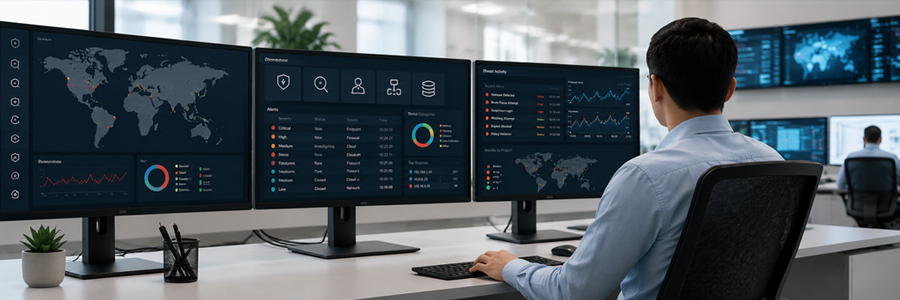
A cyber attack doesn’t happen like in the movies: a single hacker tearing through defenses in a matter of minutes. Before cybercriminals can steal your data or disrupt your operations, they typically spend weeks or months quietly probing your network for weaknesses. A security operations center (SOC) detects and stops those threats before they become costly incidents, making it a powerful but complex cybersecurity asset.
For many mid-market and enterprise organizations, partnering with a managed SOC provider delivers enterprise-grade security around the clock without the expense of building an internal team.
What is a security operations center?
A SOC is a centralized team of cybersecurity professionals responsible for monitoring, detecting, investigating, and responding to cyber threats 24 hours a day, seven days a week. Think of it as your organization’s cybersecurity command center.
Rather than waiting for an attack to unfold, a SOC uses advanced monitoring platforms, threat intelligence, and automation to continuously analyze activity across your network. The analysts who operate your SOC work to identify suspicious behavior in your servers, cloud environments, endpoints, applications, and user accounts before it develops into a serious security incident.
A modern SOC performs these tasks and many others, such as:
- Monitoring security alerts across your IT environment
- Investigating suspicious activity
- Responding to active cyber attacks
- Hunting for hidden threats that bypass automated defenses
- Coordinating incident response and recovery
- Producing security reports and compliance documentation
Unlike traditional security tools such as antivirus software or firewalls that work independently, a SOC integrates multiple technologies helmed by experienced analysts to provide continuous threat monitoring and protection.
How do enterprise business networks benefit from a SOC?
Enterprise businesses in particular benefit from a SOC because of the complexity of their IT infrastructure. Multiple offices, cloud platforms, remote employees, third-party vendors, and connected devices all create additional opportunities for attackers and must each be addressed.
A SOC helps you manage this complexity by providing complete visibility across your environment. Instead of monitoring dozens of separate security tools individually, SOC analysts view everything from a centralized platform and investigate events in context.
This proactive approach provides several important advantages:
- Faster detection of cyber threats
- Quicker incident response
- Reduced downtime
- Better compliance reporting
- Improved protection against ransomware, phishing, insider threats, and advanced attacks
As a result, you minimize cybersecurity incidents as well as their impact without placing additional pressure on your IT department. Your organization can work productively without fear of expensive and prolonged cyber attacks, and your in-house IT security team can focus on your core operations.
What are managed security operations center services?
Managed SOC services, also known as SOC-as-a-Service (SOCaaS), allow you to outsource SOC capabilities to a managed services provider (MSP) instead of investing inordinate amounts of time and money building one yourself.
Rather than taking on the burdens of recruiting cybersecurity specialists, purchasing expensive monitoring platforms, and staffing a 24/7 operation, a third-party provider delivers these services as a subscription. This dramatically reduces your initial investment, guarantees predictable cybersecurity expenses every month, and ensures your SOC stays up to date without draining your resources.
Managed SOC services deliver the same capabilities and advantages you would get doing it yourself, only better and more cost-effectively.
Because managed SOC providers serve many organizations, they stay at the forefront of cybersecurity technology and continuously refine their detection methods and response capabilities. So, your organization gets the strongest possible security posture that is constantly upgraded to defend against new threats, all without having to invest in, build, and maintain your own SOC.
What is the difference between managed SIEM and SOC?
If you have heard of security information and event management (SIEM) before, it can be easy to confuse SIEM services with SOC services. But, they are not the same thing.
A managed SIEM solution is also operated by an MSP, but it focuses primarily on collecting, storing, and analyzing security logs from across your IT environment. It generates alerts when suspicious activity occurs and helps organizations meet compliance requirements.
A managed SOC includes SIEM technology but adds the human expertise needed to investigate and respond to those alerts.
In short:
- A managed SIEM gathers data and creates alerts.
- A managed SOC reviews those alerts, determines whether they represent real threats, investigates incidents, and coordinates the appropriate response.
SIEM provides visibility into the threats, and the SOC takes action against them.
Managed SOC vs. in-house SOC
Some large enterprises choose to operate their own SOC. While this provides maximum control, it also requires significant investment.
Building your own on-premises SOC means hiring experienced security analysts, purchasing full tech stacks of advanced tools, developing incident response processes, maintaining threat intelligence feeds, providing continuous training, and much more. Most importantly, a true SOC requires around-the-clock staffing by highly trained IT personnel, skyrocketing your labor costs.
External SOC services eliminate much of this burden.
Instead of building everything yourself, you gain immediate access to an established team of cybersecurity professionals supported by mature processes and enterprise-grade security technologies, all included in your monthly fee.
Compared to an in-house SOC, managed SOC services provide:
- Lower operational costs
- Faster deployment
- 24/7 monitoring without staffing challenges
- Access to experienced security specialists
- Continuous updates to security controls
- Predictable monthly expenses
With an MSP managing your SOC, your internal IT team can then focus on strategic projects that support business growth, further increasing your cost savings and revenue.
We have existing security infrastructure. Does our enterprise really need a managed SOC team?
Not every organization requires a fully staffed internal SOC, but almost every medium-sized or enterprise business benefits from continuous security monitoring.
You should strongly consider managed SOC services if your organization:
- Stores sensitive customer or financial data
- Operates in regulated industries
- Supports remote or hybrid employees
- Uses multiple cloud environments
- Is in an industry with high cyber risk (manufacturing, finance, technology, professional services, etc.)
- Has limited internal cybersecurity resources
- Needs 24/7 monitoring but can’t justify building an internal SOC
As cyber attacks become more sophisticated, responding after an incident is no longer enough for enterprise cybersecurity. To get continuous monitoring, rapid threat detection, and expert incident response to keep your organization protected and competitive, contact Soteria today.