We all have that one neighbor with a car alarm that wails at all hours of the night. At first, you peek through the blinds to check for thieves, but after the tenth false alarm in a single week, you just roll over and go back to sleep.
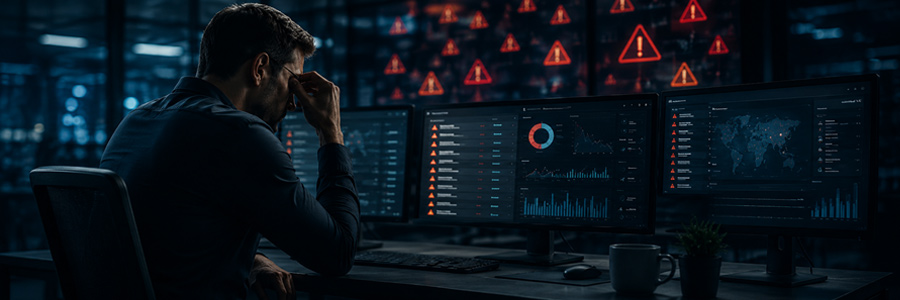
IT departments experience the same phenomenon with their security alerts. When an overwhelming number of notifications flood the dashboard, security professionals quickly become desensitized to the constant noise. Security alert fatigue sets in when everything flashes red and demands immediate attention, making it difficult to identify genuine threats among the daily chaos.
The alert fatigue cybersecurity teams experience can cause your staff to miss critical threats, leaving your organization vulnerable to a data breach, which is why you must actively combat alert fatigue.
The real cost of alert overload and excessive false positives
The sheer volume of daily warnings overwhelms mid-sized and enterprise security teams. Analysts are left staring at screens filled with constant alerts, trying to determine which ones actually matter to the business. The sheer volume of alerts places a heavy burden on your employees, leading directly to mental and operational exhaustion. Eventually, good talent may leave your company because the stress of managing an endless alert volume becomes completely unbearable.
High turnover rates weaken your internal incident response capabilities. New hires need significant time to learn the environment, but they immediately face the same brutal alert storming that drove away their predecessors. The vicious cycle continues as security analysts struggle to keep their heads above water while reviewing countless irrelevant alerts. Management often struggles to understand why their expensive software keeps missing actual attacks while generating mountains of useless paperwork.
The thing is, hackers actively weaponize alert fatigue by intentionally flooding security operations centers (SOCs) with useless data to distract your staff. While your team chases frustrating false alarms, the attackers quietly execute devastating security breaches in the background. They know your team cannot look at every single notification.
Failing to reduce alert fatigue carries a steep price tag for any enterprise. Consider the infamous Target breach in 2013. Their intrusion detection systems actually caught the initial malicious activity. Sadly, the warning got completely lost in a massive sea of low-priority alerts. The team suffered from severe SOC alert fatigue, leading to missed threats and massive financial losses.
| Approach | Focus | Outcome |
| Reactive model | Counting security alerts and chasing false positives | High stress and delayed response times |
| Proactive insights | Analyzing security data and validating cyberthreats | Faster mitigation and reduced burnout |
Transforming noise into actionable intelligence for better incident response
Fixing the underlying problem requires moving away from simply collecting raw logs from various security tools to actively analyzing them for proper context. Data context analysis provides the clarity needed to spot real threats before they cause catastrophic damage to your infrastructure.
You can further achieve better results by filtering the input directly at the source. Using machine learning and advanced technology, you can identify complex patterns hidden deep within the noise and automatically group related alerts. Doing so helps analysts paint a complete picture of an attack and understand the full scope of the danger much faster than reviewing isolated incidents.
Another important strategy is to leverage automated triage. Automation handles the boring, repetitive tasks, allowing humans to focus exclusively on complex problem-solving and strategy. Implementing powerful automation tools enables rapid threat intelligence lookups without requiring any manual intervention. Your team receives highly actionable alerts instead of a massive, unorganized pile of raw data.
Overcoming alert fatigue in cybersecurity with better detection rules
Creating a sustainable environment requires adjusting your internal technical expectations. You must actively tune your software to escalate only the most important items. Review your existing detection rules and update them to reflect your current network architecture. Outdated detection logic will always trigger alerts that waste valuable human hours, and substandard configurations easily generate false positives that drag down your team’s overall morale.
Focus heavily on asset criticality when prioritizing your daily responses. A warning from a public web server demands a completely different reaction than a warning from an isolated test machine. Categorizing network assets helps analysts quickly distinguish real threats from minor, harmless anomalies. It also prevents severe critical alerts from getting buried under a pile of useless notifications.
Most importantly, establish strong feedback loops between your frontline analysts and your backend engineers. When analysts constantly encounter redundant alerts, they must have a simple, straightforward process to report them. Engineers can then adjust the configurations to stop the unnecessary alerts from happening again. Continuous improvement drastically increases your overall operational efficiency and keeps your teams happy.
Improving alert management to reduce cybersecurity alert fatigue
Use automated remediation for handling common, low-priority events. If a known safe background process repeatedly triggers a warning, let the software handle the dismissal automatically. Reserve your human talent for complex threat hunting and investigating severe critical incidents.
Having too many tools also often creates more problems than it solves. As such, consolidate your software stack to reduce the number of overlapping, confusing notifications. A unified dashboard provides much better visibility and helps prevent dangerous delayed responses during an actual crisis.
How Soteria filters the alert volume to combat alert fatigue
Soteria’s managed detection and response (MDR) and managed SOC services provide robust 24/7/365 monitoring to extend your team’s capabilities without adding expensive internal headcount. Our highly trained experts handle the grueling night shifts and weekend coverage, taking over the heavy burden of alert management.
We filter out the excessive false positives, ensuring your staff deals only with validated emergencies. Our analysts carefully review incoming security data, eliminating noise and immediately highlighting critical threats. This approach reduces the daily volume of alerts and prevents your team from becoming overwhelmed by irrelevant notifications.
Our service also actively consolidates alerts to streamline your defense strategy. By fine-tuning your endpoint protection and other security tools, we help generate fewer false positives over time, systematically addressing alert fatigue at its root. Your IT team gets a cleaner, more accurate stream of information that brings immediate relief to your overwhelmed technical staff.
Beyond technical filtering, we transform raw events into clear, strategic insights for the C-suite. We analyze alert severity and provide executive summaries that give business leaders precise visibility into their true risk level without drowning them in technical jargon. Partnering with Soteria means gaining peace of mind, knowing professionals are continuously watching your network and delivering actionable intelligence.
Outsourcing the first line of defense protects your internal team from severe alert fatigue in cybersecurity. Let specialists handle the heavy volume while your staff focuses purely on strategic, long-term improvements.
Schedule a consultation with Soteria’s security advisors to discuss streamlining your alert management and strengthening your overall defense.